PolarDB-X HTAP架构更多信息,请参见混合负载HTAP。
HTAP集群
您购买的PolarDB-X主实例,主要面向在线通用业务场景。如果业务针对同一份数据有分析、专注离线拖数、跑批等场景,您可以在PolarDB-X主实例上购买多个只读实例。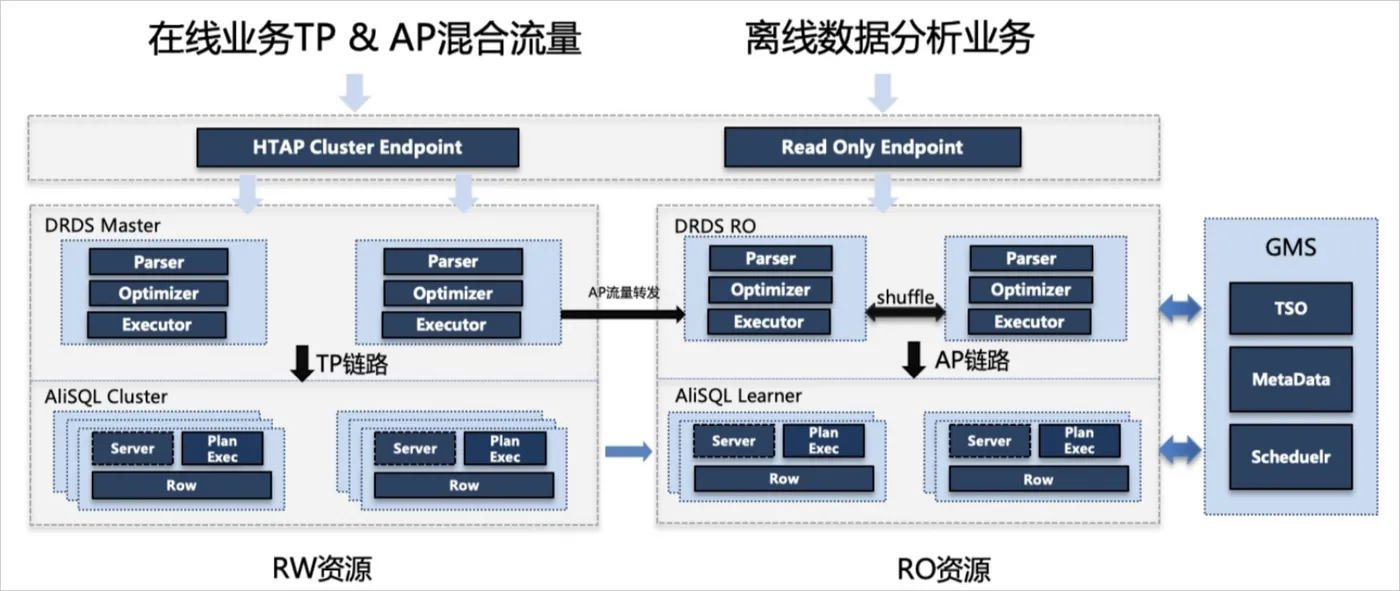 业务如果有在线HTAP混合流量或者读写分离的需求,推荐使用集群地址。PolarDB-X内部会基于智能路由或者读写权重将部分流量转发给只读实例;业务上只有离线数据分析需求时,推荐使用只读地址,只读地址会直接访问只读实例,只读地址的流量会采用MPP加速。关于连接地址信息,请参见集群地址和只读地址。
路由
智能路由
PolarDB-X优化器会基于代价分析出查询物理扫描行数、CPU、内存、IO、网络等核心资源消耗量,将请求区分为TP与AP负载。当您在集群地址上开启了智能路由,会主动识别SQL的工作负载类型来做路由,比如将识别为AP负载的流量路由给只读实例。您可以通过explain cost指令查看SQL工作负载类型的识别情况。例如以下查询,该查询涉及到物理扫描行数rowcount很小,计算资源(CPU&Memory)也消耗比较少,所以这个查询被识别为TP负载。
mysql> explain cost  select a.k, count(*) cnt from sbtest1 a, sbtest1 b where a.id = b.k and a.id > 1000 group by k having cnt > 1300 order by cnt limit 5, 10;                                                                                                                                                                                                                                                           |
+-----------------------------------------------------------------------------------------------------------------------------------------------------------------------------------------------------------------------------------------------------------------------------------+
| TopN(sort="cnt ASC", offset=?2, fetch=?3): rowcount = 1.0, cumulative cost = value = 2.8765038E7, cpu = 37.0, memory = 64.0, io = 3.0, net = 5.75, id = 163602178                                                                                                                 |
|   Filter(condition="cnt > ?1"): rowcount = 1.0, cumulative cost = value = 2.8765026E7, cpu = 26.0, memory = 47.0, io = 3.0, net = 5.75, id = 163602177                                                                                                                            |
|     HashAgg(group="k", cnt="COUNT()"): rowcount = 1.0, cumulative cost = value = 2.8765025E7, cpu = 25.0, memory = 47.0, io = 3.0, net = 5.75, id = 163602171                                                                                                                     |
|       BKAJoin(condition="k = id", type="inner"): rowcount = 1.0, cumulative cost = value = 2.8765012E7, cpu = 12.0, memory = 18.0, io = 3.0, net = 5.75, id = 163602169                                                                                                           |
|         Gather(concurrent=true): rowcount = 1.0, cumulative cost = value = 2.3755003E7, cpu = 3.0, memory = 0.0, io = 1.0, net = 4.75, id = 163602164                                                                                                                             |
|           LogicalView(tables="[000000-000003].sbtest1_[00-15]", shardCount=16, sql="SELECT `id`, `k` FROM `sbtest1` AS `sbtest1` WHERE (`id` > ?)"): rowcount = 1.0, cumulative cost = value = 2.3755002E7, cpu = 2.0, memory = 0.0, io = 1.0, net = 4.75, id = 163601451         |
|         Gather(concurrent=true): rowcount = 1.0, cumulative cost = value = 5003.0, cpu = 3.0, memory = 0.0, io = 1.0, net = 0.0, id = 163602167                                                                                                                                   |
|           LogicalView(tables="[000000-000003].sbtest1_[00-15]", shardCount=16, sql="SELECT `k` FROM `sbtest1` AS `sbtest1` WHERE ((`k` > ?) AND (`k` IN (...)))"): rowcount = 1.0, cumulative cost = value = 5002.0, cpu = 2.0, memory = 0.0, io = 1.0, net = 0.0, id = 163601377 |                                                                                                                                                                                                                                                                    |
| WorkloadType: TP                                                                                                                                                                                                                                                                  |                                                                                                                                                                                                                                                            |
+-----------------------------------------------------------------------------------------------------------------------------------------------------------------------------------------------------------------------------------------------------------------------------------+
工作负载的识别,对于HTAP路由至关重要。这里也允许您通过HINT WORKLOAD_TYPE指定工作负载。同样以上述查询为例,可以将查询负载强制指定为AP。
mysql> explain cost /*+TDDL:WORKLOAD_TYPE=AP*/ select a.k, count(*) cnt from sbtest1 a, sbtest1 b where a.id = b.k and a.id > 1000 group by k having cnt > 1300 order by cnt limit 5, 10; |
+-----------------------------------------------------------------------------------------------------------------------------------------------------------------------------------------------------------------------------------------------------------------------------------+| TopN(sort="cnt ASC", offset=?2, fetch=?3): rowcount = 1.0, cumulative cost = value = 2.8765038E7, cpu = 37.0, memory = 64.0, io = 3.0, net = 5.75, id = 163602178 |
| Filter(condition="cnt > ?1"): rowcount = 1.0, cumulative cost = value = 2.8765026E7, cpu = 26.0, memory = 47.0, io = 3.0, net = 5.75, id = 163602177 |
| HashAgg(group="k", cnt="COUNT()"): rowcount = 1.0, cumulative cost = value = 2.8765025E7, cpu = 25.0, memory = 47.0, io = 3.0, net = 5.75, id = 163602171 |
| BKAJoin(condition="k = id", type="inner"): rowcount = 1.0, cumulative cost = value = 2.8765012E7, cpu = 12.0, memory = 18.0, io = 3.0, net = 5.75, id = 163602169 |
| Gather(concurrent=true): rowcount = 1.0, cumulative cost = value = 2.3755003E7, cpu = 3.0, memory = 0.0, io = 1.0, net = 4.75, id = 163602164 |
| LogicalView(tables="[000000-000003].sbtest1_[00-15]", shardCount=16, sql="SELECT `id`, `k` FROM `sbtest1` AS `sbtest1` WHERE (`id` > ?)"): rowcount = 1.0, cumulative cost = value = 2.3755002E7, cpu = 2.0, memory = 0.0, io = 1.0, net = 4.75, id = 163601451 |
| Gather(concurrent=true): rowcount = 1.0, cumulative cost = value = 5003.0, cpu = 3.0, memory = 0.0, io = 1.0, net = 0.0, id = 163602167 |
| LogicalView(tables="[000000-000003].sbtest1_[00-15]", shardCount=16, sql="SELECT `k` FROM `sbtest1` AS `sbtest1` WHERE ((`k` > ?) AND (`k` IN (...)))"): rowcount = 1.0, cumulative cost = value = 5002.0, cpu = 2.0, memory = 0.0, io = 1.0, net = 0.0, id = 163601377 | |
| WorkloadType: AP | |
+-----------------------------------------------------------------------------------------------------------------------------------------------------------------------------------------------------------------------------------------------------------------------------------+
规则路由
除了基于代价的智能路由以外,我们也支持基于读写规则的路由。允许您在控制台参数管理上设置读写分离权重参数MASTER_READ_WEIGHT,默认值为100,可配置值区间[0, 100]。如果配置为Weight=60,意味着占60%的流量会继续在主实例执行,40%的剩余流量会路由到只读实例执行,如果只读实例有多个会进行自动分配。
智能路由和规则路由这两者关系是解耦的,具体关系请查看下表格。
| 智能路由规则 | 规则路由 (MASTER_READ_WEIGHT) | 路由结果 |
| 开启 | 以代价的读写分离为主规则路由建议保持默认值为100 |
|
| 关闭 | 以规则的读写分离为主规则路由的可选范围:[0-100] |
|
执行模式
目前PolarDB-X支持了三种执行模式:
- 单机单线程(TP_LOCAL):查询过程中,是单线程计算,TP负载的查询涉及到的扫描行数比较少,往往会采样这种执行模式,比如基于主键的点查。
- 单机并行(AP_LOCAL):查询过程中,会利用节点的多核资源做并行计算,您在没有购买只读实例的前提下,针对AP负载的查询,往往会采样这种执行模式,一般也称之为Parallel Query模式。
- 多机并行(MPP):您若购买了只读实例,针对AP负载的查询,可以协调只读实例上多个节点的多核做分布式多机并行加速。
为了让您可以准确知道执行模式,我们在原有EXPLAIN指令上,扩展出了EXPLAIN PHYSICAL。例如以下查询,通过指令可以查看到当前查询采样的是MPP模式,此外还可以获取到每个执行片段的并发数。
mysql> explain physical select a.k, count(*) cnt from sbtest1 a, sbtest1 b where a.id = b.k and a.id > 1000 group by k having cnt > 1300 or
der by cnt limit 5, 10;
+-------------------------------------------------------------------------------------------------------------------------------------------------------------------+
| PLAN                                                                                                                                                              |
+-------------------------------------------------------------------------------------------------------------------------------------------------------------------+
| ExecutorType: MPP                                                                                                                                                 |
| The Query's MaxConcurrentParallelism: 2                                                                                                                           |
| Fragment 1                                                                                                                                                        |
|     Shuffle Output layout: [BIGINT, BIGINT] Output layout: [BIGINT, BIGINT]                                                                                       |
|     Output partitioning: SINGLE [] Parallelism: 1                                                                                                                 |
|     TopN(sort="cnt ASC", offset=?2, fetch=?3)                                                                                                                     |
|   Filter(condition="cnt > ?1")                                                                                                                                    |
|     HashAgg(group="k", cnt="COUNT()")                                                                                                                             |
|       BKAJoin(condition="k = id", type="inner")                                                                                                                   |
|         RemoteSource(sourceFragmentIds=[0], type=RecordType(INTEGER_UNSIGNED id, INTEGER_UNSIGNED k))                                                             |
|         Gather(concurrent=true)                                                                                                                                   |
|           LogicalView(tables="[000000-000003].sbtest1_[00-15]", shardCount=16, sql="SELECT `k` FROM `sbtest1` AS `sbtest1` WHERE ((`k` > ?) AND (`k` IN (...)))") |
| Fragment 0                                                                                                                                                        |
|     Shuffle Output layout: [BIGINT, BIGINT] Output layout: [BIGINT, BIGINT]                                                                                       |
|     Output partitioning: SINGLE [] Parallelism: 1 Splits: 16                                                                                                      |
|     LogicalView(tables="[000000-000003].sbtest1_[00-15]", shardCount=16, sql="SELECT `id`, `k` FROM `sbtest1` AS `sbtest1` WHERE (`id` > ?)")                     |
+-------------------------------------------------------------------------------------------------------------------------------------------------------------------+
工作负载和执行模式有一定的耦合关系,AP工作负载会采用多机并行计算。同样的也允许您通过HINT EXECUTOR_MODE指定执行模式。假如主实例空闲资源很多,可以考虑强制设置为单机或者多机并行模式来加速。
mysql> explain physical /*+TDDL:EXECUTOR_MODE=AP_LOCAL*/select a.k, count(*) cnt from sbtest1 a, sbtest1 b where a.id = b.k and a.id > 1000 group by k having cnt > 1300 order by cnt limit 5, 10; |
+-------------------------------------------------------------------------------------------------------------------------------------------------------------+| ExecutorMode: AP_LOCAL |
| Fragment 0 dependency: [] parallelism: 4 |
| BKAJoin(condition="k = id", type="inner") |
| Gather(concurrent=true) |
| LogicalView(tables="[000000-000003].sbtest1_[00-15]", shardCount=16, sql="SELECT `id`, `k` FROM `sbtest1` AS `sbtest1` WHERE (`id` > ?)") |
| Gather(concurrent=true) |
| LogicalView(tables="[000000-000003].sbtest1_[00-15]", shardCount=16, sql="SELECT `k` FROM `sbtest1` AS `sbtest1` WHERE ((`k` > ?) AND (`k` IN (...)))") |
| Fragment 1 dependency: [] parallelism: 8 |
| LocalBuffer |
| RemoteSource(sourceFragmentIds=[0], type=RecordType(INTEGER_UNSIGNED id, INTEGER_UNSIGNED k, INTEGER_UNSIGNED k0)) |
| Fragment 2 dependency: [0, 1] parallelism: 8 |
| Filter(condition="cnt > ?1") |
| HashAgg(group="k", cnt="COUNT()") |
| RemoteSource(sourceFragmentIds=[1], type=RecordType(INTEGER_UNSIGNED id, INTEGER_UNSIGNED k, INTEGER_UNSIGNED k0)) |
| Fragment 3 dependency: [0, 1] parallelism: 1 |
| LocalBuffer |
| RemoteSource(sourceFragmentIds=[2], type=RecordType(INTEGER_UNSIGNED k, BIGINT cnt)) |
| Fragment 4 dependency: [2, 3] parallelism: 1 |
| TopN(sort="cnt ASC", offset=?2, fetch=?3) |
| RemoteSource(sourceFragmentIds=[3], type=RecordType(INTEGER_UNSIGNED k, BIGINT cnt)) |
+-------------------------------------------------------------------------------------------------------------------------------------------------------------+
在多机并行MPP执行模式的并发度是根据物理扫描行数、实例规格和计算所涉及到表的分表数来计算出来的,整体的并行度要考虑高并发场景,所以并行度的计算会偏保守,您可以通过上述EXPLAIN PHYSICAL指令查看并行度。当然也同样支持HINT MPP_PARALLELISM强制指定并行度,
/+TDDL:EXECUTOR_MODE=MPP MPP_PARALLELISM=8/select a.k, count(*) cnt from sbtest1 a, sbtest1 b where a.id = b.k and a.id > 1000 group by k having cnt > 1300 order by cnt limit 5, 10;
调度策略
假设您购买了多个只读实例并加入到集群地址中,您通过集群地址的查询SQL路由到只读实例的流量,会被均匀调度到只读实例多个节点上执行,调度会考虑各个节点的资源负载,确保各个节点的负载压力差不多。比如PolarDB-X会将只读实例延迟作为调度参考指标,避免将流量调度到延迟较大的只读实例上执行。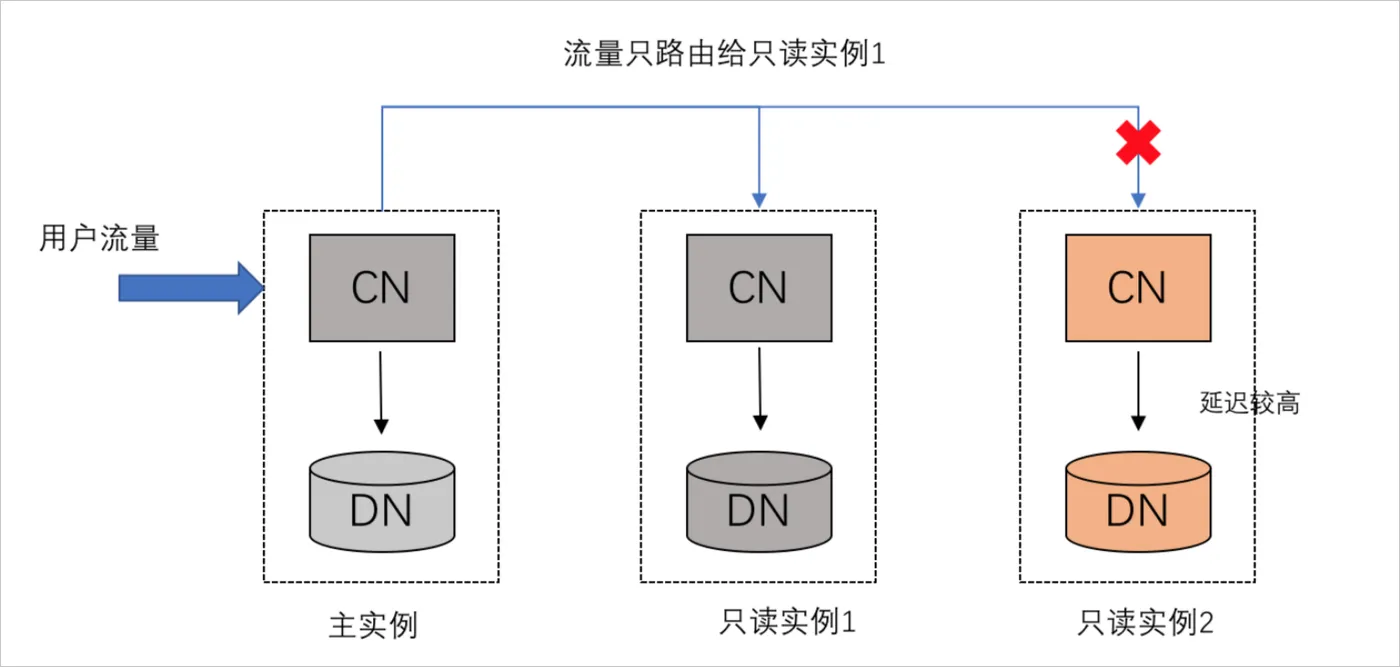
业务如果有在线HTAP混合流量或者读写分离的需求,推荐使用集群地址。PolarDB-X内部会基于智能路由或者读写权重将部分流量转发给只读实例;业务上只有离线数据分析需求时,推荐使用只读地址,只读地址会直接访问只读实例,只读地址的流量会采用MPP加速。关于连接地址信息,请参见集群地址和只读地址。
路由
智能路由
PolarDB-X优化器会基于代价分析出查询物理扫描行数、CPU、内存、IO、网络等核心资源消耗量,将请求区分为TP与AP负载。当您在集群地址上开启了智能路由,会主动识别SQL的工作负载类型来做路由,比如将识别为AP负载的流量路由给只读实例。您可以通过explain cost指令查看SQL工作负载类型的识别情况。例如以下查询,该查询涉及到物理扫描行数rowcount很小,计算资源(CPU&Memory)也消耗比较少,所以这个查询被识别为TP负载。
mysql> explain cost  select a.k, count(*) cnt from sbtest1 a, sbtest1 b where a.id = b.k and a.id > 1000 group by k having cnt > 1300 order by cnt limit 5, 10;                                                                                                                                                                                                                                                           |
+-----------------------------------------------------------------------------------------------------------------------------------------------------------------------------------------------------------------------------------------------------------------------------------+
| TopN(sort="cnt ASC", offset=?2, fetch=?3): rowcount = 1.0, cumulative cost = value = 2.8765038E7, cpu = 37.0, memory = 64.0, io = 3.0, net = 5.75, id = 163602178                                                                                                                 |
|   Filter(condition="cnt > ?1"): rowcount = 1.0, cumulative cost = value = 2.8765026E7, cpu = 26.0, memory = 47.0, io = 3.0, net = 5.75, id = 163602177                                                                                                                            |
|     HashAgg(group="k", cnt="COUNT()"): rowcount = 1.0, cumulative cost = value = 2.8765025E7, cpu = 25.0, memory = 47.0, io = 3.0, net = 5.75, id = 163602171                                                                                                                     |
|       BKAJoin(condition="k = id", type="inner"): rowcount = 1.0, cumulative cost = value = 2.8765012E7, cpu = 12.0, memory = 18.0, io = 3.0, net = 5.75, id = 163602169                                                                                                           |
|         Gather(concurrent=true): rowcount = 1.0, cumulative cost = value = 2.3755003E7, cpu = 3.0, memory = 0.0, io = 1.0, net = 4.75, id = 163602164                                                                                                                             |
|           LogicalView(tables="[000000-000003].sbtest1_[00-15]", shardCount=16, sql="SELECT `id`, `k` FROM `sbtest1` AS `sbtest1` WHERE (`id` > ?)"): rowcount = 1.0, cumulative cost = value = 2.3755002E7, cpu = 2.0, memory = 0.0, io = 1.0, net = 4.75, id = 163601451         |
|         Gather(concurrent=true): rowcount = 1.0, cumulative cost = value = 5003.0, cpu = 3.0, memory = 0.0, io = 1.0, net = 0.0, id = 163602167                                                                                                                                   |
|           LogicalView(tables="[000000-000003].sbtest1_[00-15]", shardCount=16, sql="SELECT `k` FROM `sbtest1` AS `sbtest1` WHERE ((`k` > ?) AND (`k` IN (...)))"): rowcount = 1.0, cumulative cost = value = 5002.0, cpu = 2.0, memory = 0.0, io = 1.0, net = 0.0, id = 163601377 |                                                                                                                                                                                                                                                                    |
| WorkloadType: TP                                                                                                                                                                                                                                                                  |                                                                                                                                                                                                                                                            |
+-----------------------------------------------------------------------------------------------------------------------------------------------------------------------------------------------------------------------------------------------------------------------------------+
工作负载的识别,对于HTAP路由至关重要。这里也允许您通过HINT WORKLOAD_TYPE指定工作负载。同样以上述查询为例,可以将查询负载强制指定为AP。
mysql> explain cost /*+TDDL:WORKLOAD_TYPE=AP*/ select a.k, count(*) cnt from sbtest1 a, sbtest1 b where a.id = b.k and a.id > 1000 group by k having cnt > 1300 order by cnt limit 5, 10; |
+-----------------------------------------------------------------------------------------------------------------------------------------------------------------------------------------------------------------------------------------------------------------------------------+| TopN(sort="cnt ASC", offset=?2, fetch=?3): rowcount = 1.0, cumulative cost = value = 2.8765038E7, cpu = 37.0, memory = 64.0, io = 3.0, net = 5.75, id = 163602178 |
| Filter(condition="cnt > ?1"): rowcount = 1.0, cumulative cost = value = 2.8765026E7, cpu = 26.0, memory = 47.0, io = 3.0, net = 5.75, id = 163602177 |
| HashAgg(group="k", cnt="COUNT()"): rowcount = 1.0, cumulative cost = value = 2.8765025E7, cpu = 25.0, memory = 47.0, io = 3.0, net = 5.75, id = 163602171 |
| BKAJoin(condition="k = id", type="inner"): rowcount = 1.0, cumulative cost = value = 2.8765012E7, cpu = 12.0, memory = 18.0, io = 3.0, net = 5.75, id = 163602169 |
| Gather(concurrent=true): rowcount = 1.0, cumulative cost = value = 2.3755003E7, cpu = 3.0, memory = 0.0, io = 1.0, net = 4.75, id = 163602164 |
| LogicalView(tables="[000000-000003].sbtest1_[00-15]", shardCount=16, sql="SELECT `id`, `k` FROM `sbtest1` AS `sbtest1` WHERE (`id` > ?)"): rowcount = 1.0, cumulative cost = value = 2.3755002E7, cpu = 2.0, memory = 0.0, io = 1.0, net = 4.75, id = 163601451 |
| Gather(concurrent=true): rowcount = 1.0, cumulative cost = value = 5003.0, cpu = 3.0, memory = 0.0, io = 1.0, net = 0.0, id = 163602167 |
| LogicalView(tables="[000000-000003].sbtest1_[00-15]", shardCount=16, sql="SELECT `k` FROM `sbtest1` AS `sbtest1` WHERE ((`k` > ?) AND (`k` IN (...)))"): rowcount = 1.0, cumulative cost = value = 5002.0, cpu = 2.0, memory = 0.0, io = 1.0, net = 0.0, id = 163601377 | |
| WorkloadType: AP | |
+-----------------------------------------------------------------------------------------------------------------------------------------------------------------------------------------------------------------------------------------------------------------------------------+
规则路由
除了基于代价的智能路由以外,我们也支持基于读写规则的路由。允许您在控制台参数管理上设置读写分离权重参数MASTER_READ_WEIGHT,默认值为100,可配置值区间[0, 100]。如果配置为Weight=60,意味着占60%的流量会继续在主实例执行,40%的剩余流量会路由到只读实例执行,如果只读实例有多个会进行自动分配。
智能路由和规则路由这两者关系是解耦的,具体关系请查看下表格。
| 智能路由规则 | 规则路由 (MASTER_READ_WEIGHT) | 路由结果 |
| 开启 | 以代价的读写分离为主规则路由建议保持默认值为100 |
|
| 关闭 | 以规则的读写分离为主规则路由的可选范围:[0-100] |
|
执行模式
目前PolarDB-X支持了三种执行模式:
- 单机单线程(TP_LOCAL):查询过程中,是单线程计算,TP负载的查询涉及到的扫描行数比较少,往往会采样这种执行模式,比如基于主键的点查。
- 单机并行(AP_LOCAL):查询过程中,会利用节点的多核资源做并行计算,您在没有购买只读实例的前提下,针对AP负载的查询,往往会采样这种执行模式,一般也称之为Parallel Query模式。
- 多机并行(MPP):您若购买了只读实例,针对AP负载的查询,可以协调只读实例上多个节点的多核做分布式多机并行加速。
为了让您可以准确知道执行模式,我们在原有EXPLAIN指令上,扩展出了EXPLAIN PHYSICAL。例如以下查询,通过指令可以查看到当前查询采样的是MPP模式,此外还可以获取到每个执行片段的并发数。
mysql> explain physical select a.k, count(*) cnt from sbtest1 a, sbtest1 b where a.id = b.k and a.id > 1000 group by k having cnt > 1300 or
der by cnt limit 5, 10;
+-------------------------------------------------------------------------------------------------------------------------------------------------------------------+
| PLAN                                                                                                                                                              |
+-------------------------------------------------------------------------------------------------------------------------------------------------------------------+
| ExecutorType: MPP                                                                                                                                                 |
| The Query's MaxConcurrentParallelism: 2                                                                                                                           |
| Fragment 1                                                                                                                                                        |
|     Shuffle Output layout: [BIGINT, BIGINT] Output layout: [BIGINT, BIGINT]                                                                                       |
|     Output partitioning: SINGLE [] Parallelism: 1                                                                                                                 |
|     TopN(sort="cnt ASC", offset=?2, fetch=?3)                                                                                                                     |
|   Filter(condition="cnt > ?1")                                                                                                                                    |
|     HashAgg(group="k", cnt="COUNT()")                                                                                                                             |
|       BKAJoin(condition="k = id", type="inner")                                                                                                                   |
|         RemoteSource(sourceFragmentIds=[0], type=RecordType(INTEGER_UNSIGNED id, INTEGER_UNSIGNED k))                                                             |
|         Gather(concurrent=true)                                                                                                                                   |
|           LogicalView(tables="[000000-000003].sbtest1_[00-15]", shardCount=16, sql="SELECT `k` FROM `sbtest1` AS `sbtest1` WHERE ((`k` > ?) AND (`k` IN (...)))") |
| Fragment 0                                                                                                                                                        |
|     Shuffle Output layout: [BIGINT, BIGINT] Output layout: [BIGINT, BIGINT]                                                                                       |
|     Output partitioning: SINGLE [] Parallelism: 1 Splits: 16                                                                                                      |
|     LogicalView(tables="[000000-000003].sbtest1_[00-15]", shardCount=16, sql="SELECT `id`, `k` FROM `sbtest1` AS `sbtest1` WHERE (`id` > ?)")                     |
+-------------------------------------------------------------------------------------------------------------------------------------------------------------------+
工作负载和执行模式有一定的耦合关系,AP工作负载会采用多机并行计算。同样的也允许您通过HINT EXECUTOR_MODE指定执行模式。假如主实例空闲资源很多,可以考虑强制设置为单机或者多机并行模式来加速。
mysql> explain physical /*+TDDL:EXECUTOR_MODE=AP_LOCAL*/select a.k, count(*) cnt from sbtest1 a, sbtest1 b where a.id = b.k and a.id > 1000 group by k having cnt > 1300 order by cnt limit 5, 10; |
+-------------------------------------------------------------------------------------------------------------------------------------------------------------+| ExecutorMode: AP_LOCAL |
| Fragment 0 dependency: [] parallelism: 4 |
| BKAJoin(condition="k = id", type="inner") |
| Gather(concurrent=true) |
| LogicalView(tables="[000000-000003].sbtest1_[00-15]", shardCount=16, sql="SELECT `id`, `k` FROM `sbtest1` AS `sbtest1` WHERE (`id` > ?)") |
| Gather(concurrent=true) |
| LogicalView(tables="[000000-000003].sbtest1_[00-15]", shardCount=16, sql="SELECT `k` FROM `sbtest1` AS `sbtest1` WHERE ((`k` > ?) AND (`k` IN (...)))") |
| Fragment 1 dependency: [] parallelism: 8 |
| LocalBuffer |
| RemoteSource(sourceFragmentIds=[0], type=RecordType(INTEGER_UNSIGNED id, INTEGER_UNSIGNED k, INTEGER_UNSIGNED k0)) |
| Fragment 2 dependency: [0, 1] parallelism: 8 |
| Filter(condition="cnt > ?1") |
| HashAgg(group="k", cnt="COUNT()") |
| RemoteSource(sourceFragmentIds=[1], type=RecordType(INTEGER_UNSIGNED id, INTEGER_UNSIGNED k, INTEGER_UNSIGNED k0)) |
| Fragment 3 dependency: [0, 1] parallelism: 1 |
| LocalBuffer |
| RemoteSource(sourceFragmentIds=[2], type=RecordType(INTEGER_UNSIGNED k, BIGINT cnt)) |
| Fragment 4 dependency: [2, 3] parallelism: 1 |
| TopN(sort="cnt ASC", offset=?2, fetch=?3) |
| RemoteSource(sourceFragmentIds=[3], type=RecordType(INTEGER_UNSIGNED k, BIGINT cnt)) |
+-------------------------------------------------------------------------------------------------------------------------------------------------------------+
在多机并行MPP执行模式的并发度是根据物理扫描行数、实例规格和计算所涉及到表的分表数来计算出来的,整体的并行度要考虑高并发场景,所以并行度的计算会偏保守,您可以通过上述EXPLAIN PHYSICAL指令查看并行度。当然也同样支持HINT MPP_PARALLELISM强制指定并行度,
/+TDDL:EXECUTOR_MODE=MPP MPP_PARALLELISM=8/select a.k, count(*) cnt from sbtest1 a, sbtest1 b where a.id = b.k and a.id > 1000 group by k having cnt > 1300 order by cnt limit 5, 10;
调度策略
假设您购买了多个只读实例并加入到集群地址中,您通过集群地址的查询SQL路由到只读实例的流量,会被均匀调度到只读实例多个节点上执行,调度会考虑各个节点的资源负载,确保各个节点的负载压力差不多。比如PolarDB-X会将只读实例延迟作为调度参考指标,避免将流量调度到延迟较大的只读实例上执行。