开发者学堂课程【人工智能必备基础:概率论与数理统计:案例:回归求解】学习笔记,与课程紧密联系,让用户快速学习知识。
课程地址:https://developer.aliyun.com/learning/course/545/detail/7442
案例:回归求解
一、Lasso 回归
X[ 1,1,1,1]W1[1/4,1/4,1/4,1/4],w2[1,0,0,0], w1 和 w2 相加起来都等于1. 区分:趋势不同,w1 趋势更稳定,能处理更多类型的数据。
多加了一个绝对值项来惩罚过大的系数,alphas=0 那就是最小二乘了(表示惩罚力度)
In (1078]: # logarithmic scale: log base 2# high values to rero-out more variables
alphas=2.**k np. arange(2, 12)(选择不同的参数)scores . np. empty_like (alphas)for i, a in enumerate (alphas) :lasso . Lasso (random_state = seed)(指定好模型)
lasso. set_params (alpha = a)(指定惩罚力度)lasso. fit(X_ train, y_train)scores[i] = lasso. score(X_ test, y. test)(结果值是由测试集进行计算的,训练集只是建立方程,测试集是利用方程进行结果的评估)(一般测试集只是用来选参数)
(交叉验证)lassocv = LassoCV(cv = 10, random state F seed)(指定交叉验证的个数)
lassocv, fit (features, target)(将原始数据存入)lassocv_ score = lassocv. score (features, target)(得到 score 值)
lassocv_ alpha = lassocv. alpha_(将 α 值拿出)
plt. figure(figsize = (10, 4))
plt. plot (alphas, scores,’ -ko’ )plt. axhline (lassocv score, color = c)
plt. xlabel(r’ $\alpha$’ )
plt. ylabel(‘CV Score’)plt. xscale (‘log’,basex=2)sns. despine(offset=15)
print(‘CV results:’, lassocv_ score, lassocv. _alpha)
CV results: 0826897171636 225757779669
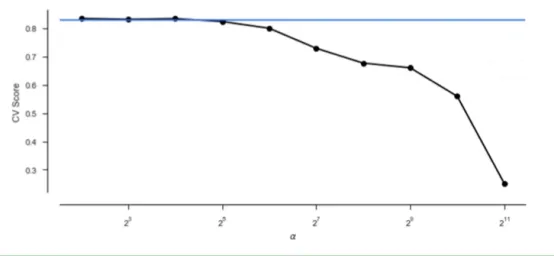
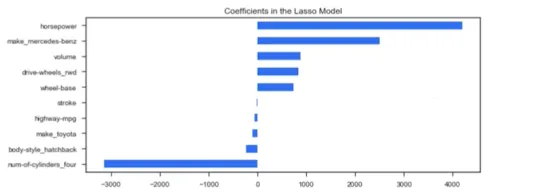
lt’s already a good result: R squared of 0.82. Let’s take a look a the features contributing to the model.In [1115]: a lassocv coefficientscoefs = pd. Series(lassocv. coef_ . index =features. columns)(将系数都拿出)# prints out the number of picked/eliminated/featuresprint( “Lasso picked”+ str( sum(coefs!=0))+”features and eliminated the otherstr(sum(coefs ==0))+” features”.)# takes first and last 10coefs =pd.concat([coefs. sort values(). head(5),coefs.sortvalues().tail(5)])plt. figure(figsize = (10, 4))coefs. plot(kind =” barh”, color= c)plt. title("Coefficients in the Lasso Model)
plt. show()Lasso picked 13 features and eliminated the other52 features.
In [1080]: model_11 = LassoCV(alphas = alphas, cv =10, random_state = seed).fit(X train. y_ train)y_ pred_ 11 = mode1_ 11. predict(x test)model_ 11. score(X_ test, y_ test)
Out[1080]: 0. 83307445226244159We get higher score on the test than on the train set, which showsthat the model can propbably generalize well on the unseen data.In (1113]: =# residual plotplt. rcParams[‘ figure. Figsize’] = (6.0, 6. 0)preds = pd. DataFrame(“preds “: model_11. predict(X_ train), “true": y _train))(将当前结果导入)
preds[" residuals “] = preds[" true"] preds[preds" ]preds. plot(x = preds , y = residuals, kind = scatter, color = c)Out(1113]: <matplotlib. axes. _ subplots. AxesSubplot at 0x15c9f48d0>
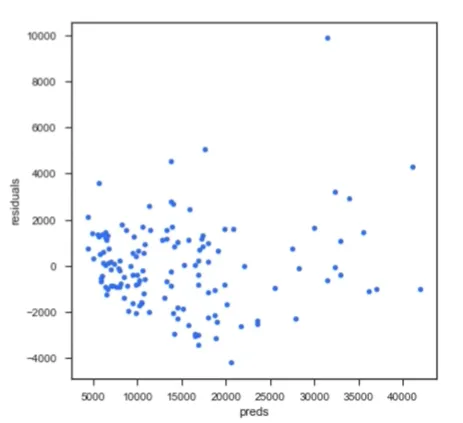
可用 x 值表示预测值,y 值表示之间的差异。
In [1082]: def MSE(y_ true,y_ pred):mse = mean_squared_error(y_true, y_pred)
print(‘MSE:% 92. 3f’% mse)return msedef R2(y_true,y_pred):r2 = r2_score(y_true, y_pred)
print(‘ R2: %2. 3f’% r2)return r2MSE(y_test, y_pred _11);(表示局方误差)
R2(y_test, y_pred 11);MSE: 3870543. 789
R2: 0.833In [1083]: # predictionsd= (‘ true’: list(y_ test),‘predicted&apos’ : pd. Series(y_pred_11)
}pd. DataFrame (d). head()
Out[1083]:
Predicted true
0 8698.454622 8499.0
1 16848.107734 17450.0
2 11050.616354 9279.0
3 10177.257093 7975.0
4 6505.098638 6692.0
scikit-learn 的用法:
进入 Linear Models,刚才使用的是linear_model.Lasso([alpha,fit_intercept,…])(表示交叉验证)linear_model.LassoCV([eps,n_alphas,…])(直接进行建模)。比如对模块不熟悉,点击进入查看即可。可看到公式既公式是怎么算的。也会说明 α 的作用。会有例子。会说明用 scikit-learn 进行弧边模型的建立。scikit-learn 里的 API 可以帮助找到你想要的。