
徐春阳老师发文爆MySQL 8.0 hash join有重大缺陷。
文章核心观点如下:多表(比如3个个表)join时,只会简单的把表数据量小的放在前面作为驱动表,大表放在最后面,从而导致可能产生极大结果集的笛卡尔积,甚至耗尽CPU和磁盘空间。
就此现象,我也做了个测试。
1. 利用TPC-H工具准备测试环境
TPC-H工具在这里下载 http://www.tpc.org/tpch/default5.asp。默认并不支持MySQL,需要自己手动做些调整,参见 https://imysql.com/2012/12/21/tpch-for-mysql-manual.html。
在本案中,我指定的 Scale Factor 参数是10,即:
[root@yejr.run dbgen]# ./dbgen -s 10 && ls -l *tbl
-rw-r--r-- 1 root root  244847642 Apr 14 09:52 customer.tbl
-rw-r--r-- 1 root root 7775727688 Apr 14 09:52 lineitem.tbl
-rw-r--r-- 1 root root       2224 Apr 14 09:52 nation.tbl
-rw-r--r-- 1 root root 1749195031 Apr 14 09:52 orders.tbl
-rw-r--r-- 1 root root  243336157 Apr 14 09:52 part.tbl
-rw-r--r-- 1 root root 1204850769 Apr 14 09:52 partsupp.tbl
-rw-r--r-- 1 root root        389 Apr 14 09:52 region.tbl
-rw-r--r-- 1 root root   14176368 Apr 14 09:52 supplier.tbl
2. 创建测试表,导入测试数据。
查看几个表的数据量分别是:
+----------+------------+----------+----------------+-------------+--------------+
| Name | Row_format | Rows | Avg_row_length | Data_length | Index_length |+----------+------------+----------+----------------+-------------+--------------+
| customer | Dynamic | 1476605 | 197 | 291258368 | 0 |
| lineitem | Dynamic | 59431418 | 152 | 9035579392 | 0 |
| nation | Dynamic | 25 | 655 | 16384 | 0 |
| orders | Dynamic | 14442405 | 137 | 1992294400 | 0 |
| part | Dynamic | 1980917 | 165 | 327991296 | 0 |
| partsupp | Dynamic | 9464104 | 199 | 1885339648 | 0 |
| region | Dynamic | 5 | 3276 | 16384 | 0 |
| supplier | Dynamic | 99517 | 184 | 18366464 | 0 |
+----------+------------+----------+----------------+-------------+--------------+
提醒:几个测试表都不要加任何索引,包括主键,上表中 Index_length的值均为0。
3. 运行测试SQL
本案选用的MySQL版本是8.0.19:
[root@yejr.run]> \s
...
Server version:         8.0.19-commercial MySQL Enterprise Server - Commercial
...
徐老师是在用TPC-H中的Q5时遇到的问题,本案也同样选择这个SQL。
不过,本案主要测试Hash Join,因此去掉了其中的GROUP BY和ORDER BY子句。
先看下执行计划吧,都是全表扫描,好可怕...
[root@yejr.run]> desc select count(*)
-> from
->     customer,
->     orders,
->     lineitem,
->     supplier,
->     nation,
->     region
-> where
->     c_custkey = o_custkey
->     and l_orderkey = o_orderkey
->     and l_suppkey = s_suppkey
->     and c_nationkey = s_nationkey
->     and s_nationkey = n_nationkey
->     and n_regionkey = r_regionkey
->     and r_name = 'AMERICA'
->     and o_orderdate >= date '1993-01-01'
->     and o_orderdate < date '1993-01-01' + interval '1' year;
+----------+------+----------+----------+----------------------------------------------------+
| table    | type | rows     | filtered | Extra                                              |
+----------+------+----------+----------+----------------------------------------------------+
| region   | ALL  |        5 |    20.00 | Using where                                        |
| nation   | ALL  |       25 |    10.00 | Using where; Using join buffer (Block Nested Loop) |
| supplier | ALL  |    98705 |    10.00 | Using where; Using join buffer (Block Nested Loop) |
| customer | ALL  |  1485216 |    10.00 | Using where; Using join buffer (Block Nested Loop) |
| orders   | ALL  | 14932433 |     1.11 | Using where; Using join buffer (Block Nested Loop) |
| lineitem | ALL  | 59386314 |     1.00 | Using where; Using join buffer (Block Nested Loop) |
+----------+------+----------+----------+----------------------------------------------------+
加上 format=tree 再看下(真壮观啊。。。)
 1. row **
EXPLAIN: -> Aggregate: count(0)
-> Inner hash join (lineitem.L_SUPPKEY = supplier.S_SUPPKEY), (lineitem.L_ORDERKEY = orders.O_ORDERKEY)  (cost=40107736685515472896.00 rows=4010763818487343104)
    -> Table scan on lineitem  (cost=0.07 rows=59386314)
    -> Hash
        -> Inner hash join (orders.O_CUSTKEY = customer.C_CUSTKEY)  (cost=60799566599072.12 rows=6753683238538)
            -> Filter: ((orders.O_ORDERDATE >= DATE'1993-01-01') and (orders.O_ORDERDATE < <cache>((DATE'1993-01-01' + interval '1' year))))  (cost=0.16 rows=165883)
                -> Table scan on orders  (cost=0.16 rows=14932433)
            -> Hash
                -> Inner hash join (customer.C_NATIONKEY = nation.N_NATIONKEY)  (cost=3664985889.79 rows=3664956624)
                    -> Table scan on customer  (cost=0.79 rows=1485216)
                    -> Hash
                        -> Inner hash join (supplier.S_NATIONKEY = nation.N_NATIONKEY)  (cost=24976.50 rows=24676)
                            -> Table scan on supplier  (cost=513.52 rows=98705)
                            -> Hash
                                -> Inner hash join (nation.N_REGIONKEY = region.R_REGIONKEY)  (cost=3.50 rows=3)
                                    -> Table scan on nation  (cost=0.50 rows=25)
                                    -> Hash
                                        -> Filter: (region.R_NAME = 'AMERICA')  (cost=0.75 rows=1)
                                            -> Table scan on region  (cost=0.75 rows=5)
看起来的确是把最小的表放在最前面,把最大的放在最后面。
在开始跑之前,我们先看一眼手册中关于Hash Join的描述,其中有一段是这样的:
Memory usage by hash joins can be controlled using the join_buffer_size
system variable; a hash join cannot use more memory than this amount.
When the memory required for a hash join exceeds the amount available,
MySQL handles this by using files on disk. If thishappens, you should
be aware that the join may not succeed if a hash join cannot fit into
memory and it creates more files than set for open_files_limit. To avoid
such problems, make either of the following changes:

- Increase join_buffer_size so that the hash join does not spill over to disk.
- Increase open_files_limit.
简言之,当 join_buffer_size 不够时,会在hash join的过程中转储大量的磁盘表(把一个hash表切分成多个小文件放在磁盘上,再逐个读入内存进行hash join),因此建议加大 join_buffer_size,或者加大 open_files_limit 上限。
所以,正式开跑前,我先把join_buffer_size调大到1GB,并顺便看下其他几个参数值:
[root@yejr.run]> select @@join_buffer_size,  @@tmp_table_size,  @@innodb_buffer_pool_size;
+--------------------+------------------+---------------------------+
| @@join_buffer_size | @@tmp_table_size | @@innodb_buffer_pool_size |
+--------------------+------------------+---------------------------+
|         1073741824 |         16777216 |               10737418240 |
+--------------------+------------------+---------------------------+
并且为了保险起见,在执行SQL时也用 SET_VAR(8.0新特性) 设置了 join_bufer_size,走起。
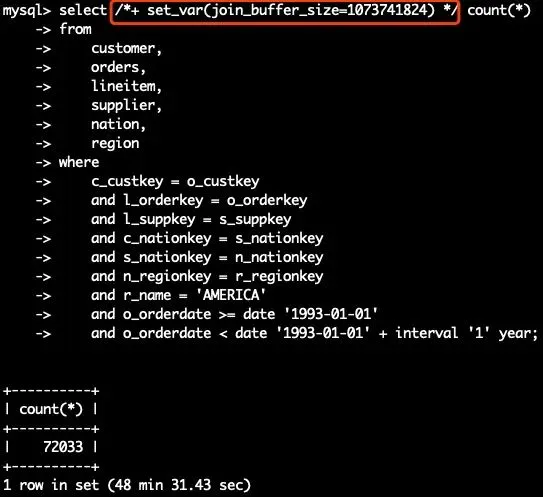
好在最后这个SQL有惊无险的执行成功,总耗时2911秒。
# Query_time: 2911.426483 Lock_time: 0.000251 Rows_sent: 1 Rows_examined: 76586082
当然了,这个SQL执行过程中的代价也确实非常大,产生了大量的磁盘(不可见)临时文件。
我每隔几秒钟就统计一次所有临时文件的总大小,并且观察磁盘空间剩余量。
/data 分区最开始可用空间是 373GB,这条SQL在峰值吃掉了约170GB,着实可怕。
# 刚开始
/dev/vdb       524032000 132967368 391064632  26% /data

# 峰值时
/dev/vdb       524032000 319732288 204299712  62% /data
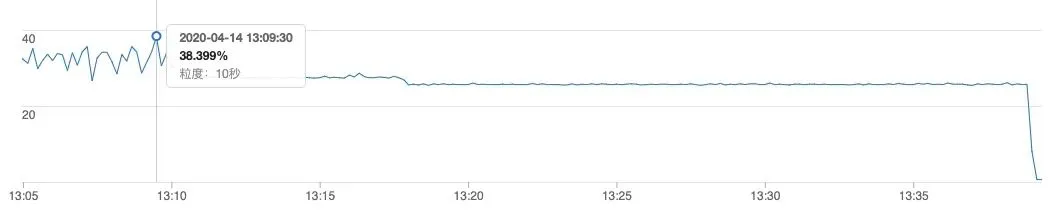
CPU的负载从监控上看倒是还算能接受,最高约38.4%
4. 补充测试
上面的测试中,优化器"擅自"修改了驱动顺序,那加上straight_join看看会怎样
[root@yejr.run]> EXPLAIN STRAIGHT_JOIN select count(*)
from
    customer straight_join
    orders  straight_join
    lineitem  straight_join
    supplier  straight_join
    nation  straight_join
    region
where
    c_custkey = o_custkey
    and l_orderkey = o_orderkey
    and l_suppkey = s_suppkey
    and c_nationkey = s_nationkey
    and s_nationkey = n_nationkey
    and n_regionkey = r_regionkey
    and r_name = 'AMERICA'
    and o_orderdate >= date '1993-01-01'
    and o_orderdate < date '1993-01-01' + interval '1' year;
+----------+----------+----------+----------------------------------------------------+
| table    | rows     | filtered | Extra                                              |
+----------+----------+----------+----------------------------------------------------+
| customer |  1485216 |   100.00 | NULL                                               |
| orders   | 14932433 |     1.11 | Using where; Using join buffer (Block Nested Loop) |
| lineitem | 59386314 |    10.00 | Using where; Using join buffer (Block Nested Loop) |
| supplier |    98705 |     1.00 | Using where; Using join buffer (Block Nested Loop) |
| nation   |       25 |    10.00 | Using where; Using join buffer (Block Nested Loop) |
| region   |        5 |    20.00 | Using where; Using join buffer (Block Nested Loop) |
+----------+----------+----------+----------------------------------------------------+

#format=tree模式下
| -> Aggregate: count(0)
    -> Inner hash join (region.R_REGIONKEY = nation.N_REGIONKEY)  (cost=204565289351994015744.00 rows=8021527039324357632)
        -> Filter: (region.R_NAME = 'AMERICA')  (cost=0.00 rows=1)
            -> Table scan on region  (cost=0.00 rows=5)
        -> Hash
            -> Inner hash join (nation.N_NATIONKEY = customer.C_NATIONKEY)  (cost=200554431911464173568.00 rows=-9223372036854775808)
                -> Table scan on nation  (cost=0.00 rows=25)
                -> Hash
                    -> Inner hash join (supplier.S_NATIONKEY = customer.C_NATIONKEY), (supplier.S_SUPPKEY = lineitem.L_SUPPKEY)  (cost=160446786739199049728.00 rows=-9223372036854775808)
                        -> Table scan on supplier  (cost=0.00 rows=98705)
                        -> Hash
                            -> Inner hash join (lineitem.L_ORDERKEY = orders.O_ORDERKEY)  (cost=16253562153466286.00 rows=16253535510797654)
                                -> Table scan on lineitem  (cost=0.01 rows=59386314)
                                -> Hash
                                    -> Inner hash join (orders.O_CUSTKEY = customer.C_CUSTKEY)  (cost=24638698342.46 rows=2736915995)
                                        -> Filter: ((orders.O_ORDERDATE >= DATE'1993-01-01') and (orders.O_ORDERDATE < <cache>((DATE'1993-01-01' + interval '1' year))))  (cost=0.94 rows=165883)
                                            -> Table scan on orders  (cost=0.94 rows=14932433)
                                        -> Hash
                                            -> Table scan on customer  (cost=153126.35 rows=1485216)
最后实际执行耗时
[root@yejr.run]> mysql> select /+ set_var(join_buffer_size=1073741824) /
 STRAIGHT_JOIN count(*)
...
+----------+
| count(*) |
+----------+
|    72033 |
+----------+
1 row in set (4 min 12.31 sec)
这个SQL执行过程中,只产生了很少几个临时文件,影响几乎可以忽略不计的那种。
这次之所以会比较快,是因为orders 表在第二顺序执行,对它还附加了WHERE条件,过滤后数据量变小了(全表1500万,过滤后227万),因此整体执行时间缩短了。
靠着 straight_join拯救了危机。
此外,在测试的过程中,我还做过一次只有3个表的全表join,下面是执行计划
[root@yejr.run]> desc select count(*) from orders o , lineitem l, partsupp ps where
o.O_CUSTKEY = l.L_SUPPKEY and l.L_PARTKEY = ps.PS_AVAILQTY;
+-------+----------+----------+----------------------------------------------------+
| table | rows     | filtered | Extra                                              |
+-------+----------+----------+----------------------------------------------------+
| ps    |  7697248 |   100.00 | NULL                                               |
| l     | 59386314 |    10.00 | Using where; Using join buffer (Block Nested Loop) |
| o     | 14932433 |    10.00 | Using where; Using join buffer (Block Nested Loop) |
+-------+----------+----------+----------------------------------------------------+
在这个执行计划中,就不会出现徐老师说的问题,不再简单的把最小的表作为驱动表,最大的表放在最后面。
这条SQL耗时304秒,还好吧。
# Query_time: 304.889654 Lock_time: 0.000178 Rows_sent: 1 Rows_examined: 82986052
写在最后
在前几天我的文章《MySQL没前途了吗?》中,其实已经说了MySQL目前不适合做OLAP业务,即便有Hash Join也不行,毕竟其适用的场景很有限。
本案中几个表完全没任何索引,这属于很极端的场景,不应该允许此类现象发生。
另外,在已经明确需要走Hash Join的情况下,就应该人为干预,提前加大join_buffer_size,减少执行过程中生成的临时文件。
当然了,如果遇到多表JOIN不符合预期时,还可以用STRAIGHT_JOIN强制设定驱动顺序,也可以规避这个问题。
不过,MySQL在偏OLAP场景上的性能的确还有很大提升空间,对此我持谨慎乐观态度,比如把ClickHouse给直接收编了呢 :)
对于本文,我心里不是很有底气,毕竟不是啥源码大神,如果理解上的错误,还请留言指正,不吝感激。
SQL优化大神郑松华对本文亦有贡献,谢谢二位老师。
全文完。
</div>