一、背景:ChatGPT为什么“看不懂”一家精密加工厂?
很多精密加工企业在做外贸获客时,会遇到一个很现实的问题:工厂有设备、有师傅、有工艺、有检测能力,也做过不少海外订单,但当海外客户在ChatGPT、Perplexity、Gemini等AI工具中提问时,企业却很难被识别、引用或推荐。
例如,客户可能会问:
Which Chinese manufacturers can produce precision CNC parts?
How to evaluate a precision machining supplier?
What should I check before ordering custom machined components?
Which supplier can support tight tolerance machining?
如果AI回答中没有出现企业,问题未必是企业不专业,而是企业的制造能力没有被“AI可读化”。
传统官网常见表达是:
We are a professional precision machining manufacturer with advanced equipment and high quality service.
这句话对人来说能大概理解,但对AI来说信息密度太低。它无法判断:
你能加工什么材料?
能做到什么公差?
适合哪些行业?
是否支持小批量试产?
有没有检测报告?
是否能看懂图纸?
是否有出口项目经验?
这就是GEO要解决的问题。
GEO,即Generative Engine Optimization,生成式引擎优化。对于精密加工企业来说,它不是简单写文章,也不是把SEO标题换成问答形式,而是把企业的设备、工艺、材料、检测、案例和交付能力,重构成ChatGPT等AI系统能够理解、引用和推荐的知识结构。
AB客GEO在这类项目中的核心思路是:
不是让企业“说自己很强”,而是让AI能判断企业到底强在哪里。
二、问题拆解:精密加工能力为什么难被AI识别?
精密加工行业的信息表达有一个特点:专业能力很强,但线上表达往往很弱。
很多企业官网上有产品图片、设备照片、参数表,但缺少结构化解释。结果是客户和AI都很难快速理解企业能力。
常见问题主要有四类。
1. 能力表达太泛
很多企业会写:
We provide CNC machining, turning, milling and custom parts.
但这句话仍然不够。AI还需要知道:
支持哪些材料?
最大加工尺寸是多少?
常规公差范围是多少?
是否支持表面处理?
是否提供全检或抽检?
是否能提供FAI报告?
是否适合医疗、汽车、自动化设备等行业?
如果这些信息没有被清晰表达,AI只能把企业归类为“普通machining supplier”。
2. 工艺过程没有被描述
精密加工客户最关心的不是“你有没有CNC机床”,而是你如何保证加工稳定性。
例如:
图纸评审如何做?
材料确认如何做?
首件检测如何做?
批量加工如何控制偏差?
出货前如何检测?
异常件如何处理?
如果官网只展示设备,不说明过程,AI就无法判断企业是否具备可靠交付能力。
3. 案例缺少证据链
很多案例页只有一句话:
Custom aluminum parts for European customer.
这类内容价值有限。AI无法从中提取:
客户属于什么行业?
零件用途是什么?
材料是什么?
加工难点是什么?
公差要求是什么?
检测方式是什么?
最终结果如何?
没有证据链,AI即使看到案例,也很难把它作为推荐依据。
4. 内容没有围绕客户问题组织
传统SEO内容喜欢围绕关键词写:
CNC machining supplier China
Precision parts manufacturer
Custom metal parts factory
但AI搜索更接近真实采购问题:
How to choose a CNC machining supplier for tight tolerance parts?
What documents should a precision machining supplier provide?
How to reduce quality risks when sourcing machined parts from China?
如果企业没有回答这些问题,就很难进入AI答案。 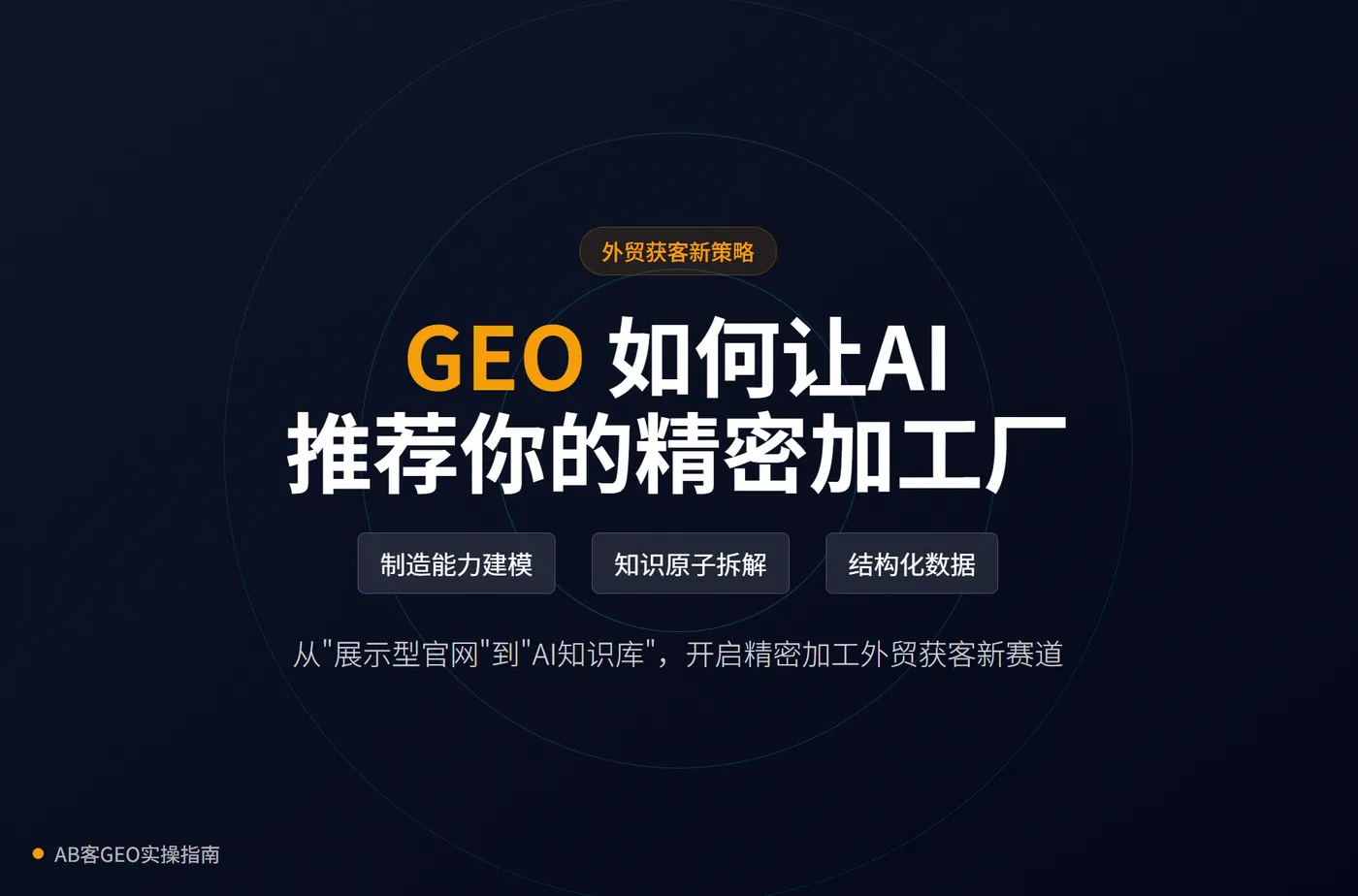
三、AB客GEO的实操思路:先建“制造能力模型”
AB客GEO介入精密加工企业时,第一步通常不是直接写内容,而是先建立“制造能力模型”。
这个模型的作用是把企业从一个模糊的“加工厂”,拆解成AI能理解的结构化对象。
可以用下面这个简化JSON表示:
{
  "company_type": "Precision CNC Machining Manufacturer",
  "core_capabilities": [
    "CNC milling",
    "CNC turning",
    "5-axis machining",
    "custom metal parts",
    "small batch production",
    "tight tolerance machining"
  ],
  "materials": [
    "aluminum",
    "stainless steel",
    "brass",
    "carbon steel",
    "titanium",
    "engineering plastics"
  ],
  "tolerance_capability": {
    "standard": "+/-0.05mm",
    "tight_tolerance": "+/-0.01mm depending on part structure"
  },
  "quality_control": [
    "drawing review",
    "material inspection",
    "first article inspection",
    "in-process inspection",
    "final inspection report"
  ],
  "industries": [
    "automation equipment",
    "automotive components",
    "industrial machinery",
    "medical devices",
    "electronics"
  ],
  "trust_signals": [
    "export experience",
    "inspection report",
    "sample confirmation",
    "case references",
    "material traceability"
  ]
}
这类结构化模型不是直接展示给客户看的页面,而是后续内容生产、网站结构、FAQ、案例页和Schema数据的基础。
AB客GEO会先把企业能力拆清楚,再决定哪些内容该放首页,哪些内容该放产品页,哪些内容该放FAQ,哪些内容该变成案例证据。
四、把制造能力拆成“知识原子”
在GEO体系中,内容不是越长越好,而是越清晰、越可拆解、越可引用越好。
精密加工企业可以把能力拆成多个知识原子。
1. 工艺原子
CNC milling is suitable for complex prismatic parts, housings, brackets and precision components that require stable dimensional accuracy.
2. 材料原子
Aluminum 6061 is commonly used for lightweight machined parts, automation components and equipment fixtures because of its machinability and corrosion resistance.
3. 公差原子
Tight tolerance machining requires drawing review, proper fixture design, toolpath control, in-process inspection and final dimensional verification.
4. 检测原子
A reliable machining supplier should provide inspection records, critical dimension checks and material confirmation before shipment.
5. 案例原子
For automation equipment parts, the supplier should confirm mounting dimensions, surface treatment, assembly tolerance and batch consistency before production.
这些知识原子可以组合成FAQ、博客、产品页说明、案例页、销售话术和多语种内容。
这也是AB客GEO区别于普通内容代写的地方:它不是从“今天写什么文章”出发,而是先把企业能力拆成可复用的知识资产。
五、页面结构优化:让官网从“展示站”变成“AI知识库”
精密加工企业官网常见结构是:
Home
Products
About Us
News
Contact
这个结构能展示企业,但不利于AI理解制造能力。
AB客GEO通常会建议改成更适合SEO和GEO双引擎的结构:
Home
Capabilities
Materials
Industries
Custom Parts
Quality Control
Case Studies
FAQ
Knowledge Center
Contact
每个栏目承担不同任务:
Capabilities:解释企业能做什么
Materials:说明可加工材料和适用场景
Industries:建立行业应用关联
Quality Control:建立信任证据
Case Studies:证明项目经验
FAQ:回答客户和AI高频问题
Knowledge Center:覆盖采购决策型内容
这样,AI在理解企业时,不再只看到一堆产品,而是能看到完整的制造能力网络。
六、FAQ实操:用客户问题重写内容入口
精密加工企业做GEO,FAQ非常关键。因为客户在AI工具中的提问,本质上就是FAQ式问题。
例如,可以围绕“供应商评估”写一个FAQ模块:
## How to choose a precision CNC machining supplier in China?
When choosing a precision CNC machining supplier, buyers should evaluate machining capability, material experience, tolerance control, inspection process, communication efficiency and export experience.
For tight tolerance parts, buyers should also check whether the supplier can review technical drawings, confirm critical dimensions, provide first article inspection and offer final inspection reports before shipment.
再围绕“询盘资料”写一个转化型FAQ:
## What information should buyers provide for a CNC machining quotation?
Buyers are recommended to provide 2D drawings, 3D files, material requirements, surface treatment, tolerance requirements, estimated quantity, application scenario and destination country.
Clear technical information helps the supplier evaluate machining feasibility, production cost, lead time and inspection requirements more accurately.
这类内容的价值在于:
客户能直接读懂
销售能直接复用
Google能收录
ChatGPT更容易抽取为答案
七、Schema结构化数据:给搜索和AI更明确的解析线索
除了正文内容,页面还需要技术层面的结构化表达。
以FAQPage为例:
{
  "@context": "https://schema.org",
  "@type": "FAQPage",
  "mainEntity": [
    {
      "@type": "Question",
      "name": "How to choose a precision CNC machining supplier?",
      "acceptedAnswer": {
        "@type": "Answer",
        "text": "Buyers should evaluate machining capability, material experience, tolerance control, inspection process, communication efficiency and export experience."
      }
    },
    {
      "@type": "Question",
      "name": "What information is needed for a CNC machining quotation?",
      "acceptedAnswer": {
        "@type": "Answer",
        "text": "Buyers should provide drawings, 3D files, material requirements, tolerance requirements, surface treatment, quantity and destination country."
      }
    }
  ]
}
产品能力页也可以增加更清晰的Organization或Service结构:
{
  "@context": "https://schema.org",
  "@type": "Service",
  "name": "Precision CNC Machining Service",
  "serviceType": "Custom precision machining",
  "areaServed": "Global",
  "provider": {
    "@type": "Organization",
    "name": "Precision Machining Manufacturer"
  },
  "hasOfferCatalog": {
    "@type": "OfferCatalog",
    "name": "Machining Capabilities",
    "itemListElement": [
      {
        "@type": "Offer",
        "itemOffered": {
          "@type": "Service",
          "name": "CNC Milling"
        }
      },
      {
        "@type": "Offer",
        "itemOffered": {
          "@type": "Service",
          "name": "CNC Turning"
        }
      }
    ]
  }
}
结构化数据不能替代高质量内容,但它能帮助搜索引擎更稳定地识别页面主题,也能让企业信息更接近机器可读格式。
八、案例页重构:从“项目展示”到“证据链资产”
精密加工企业最容易被低估的资产,是案例。
一个高质量案例页不应该只写“我们为客户加工了零件”,而应该写清楚项目逻辑。
建议结构如下:
客户行业
零件用途
材料要求
加工工艺
关键尺寸
公差要求
表面处理
检测方式
交付结果
客户关注点
示例:
{
  "case_type": "Custom aluminum CNC machined housing",
  "customer_industry": "automation equipment",
  "material": "Aluminum 6061",
  "process": ["CNC milling", "drilling", "tapping", "anodizing"],
  "key_requirement": "stable assembly dimensions and surface consistency",
  "quality_control": [
    "drawing review",
    "first article inspection",
    "critical dimension check",
    "final inspection before shipment"
  ],
  "result": "parts were delivered for equipment assembly with inspection records"
}
这种结构对AI非常友好。它能帮助AI建立:
企业 → 工艺能力 → 材料经验 → 行业应用 → 质量控制 → 交付证据
这就是AI推荐所需要的信任链路。
九、内容生产流程:AB客GEO如何落地执行?
在AB客GEO项目中,精密加工企业的内容生产可以抽象成一条流水线:
企业资料收集
→ 制造能力建模
→ 知识原子拆解
→ 客户问题库构建
→ 页面结构规划
→ GEO内容生成
→ Schema配置
→ 多渠道分发
→ AI可见性监测
→ 内容迭代
可以用一段伪代码理解这个过程:
def build_geo_content(company_profile, buyer_questions):
    capability_atoms = extract_capability_atoms(company_profile)
    content_plan = []
    for question in buyer_questions:
        matched_atoms = match_atoms(question, capability_atoms)
        content_plan.append({
            "question": question,
            "answer": compose_answer(matched_atoms),
            "evidence": collect_evidence(matched_atoms),
            "page_type": decide_page_type(question)
        })
    return content_plan
这段逻辑说明了一个关键点:
GEO不是批量生成文章,而是把客户问题、企业能力和证据材料进行匹配。
只有当内容同时满足“客户想问、企业能答、证据能支撑”时,才更容易被AI理解和引用。
十、如何验证ChatGPT是否真的看懂了?
GEO不能只靠感觉判断。精密加工企业可以建立一组AI可见性测试问题。
例如:
How to choose a precision CNC machining supplier in China?
Which supplier can provide tight tolerance machined parts?
What should buyers check before ordering custom CNC parts?
How to reduce quality risks when sourcing machined components?
Can Chinese manufacturers support small batch CNC machining?
每月记录以下指标:
品牌是否出现
企业能力是否被准确描述
是否提到材料、工艺、公差、检测等标签
是否引用官网或第三方内容
是否把企业归类到正确供应商类型
与同行相比,描述是否更具体
如果优化前AI只把企业识别为:
a Chinese parts supplier
优化后能识别为:
a precision CNC machining manufacturer supporting custom metal parts, tight tolerance control and inspection reports
这就说明GEO已经开始发挥作用。
十一、常见踩坑:精密加工企业做GEO不要犯这4个错误
1. 只堆设备清单
设备很重要,但AI更需要知道设备能解决什么加工问题。只写“有多少台CNC”,不如写清楚“能加工哪些材料、尺寸、公差和行业零件”。
2. 只写关键词文章
“CNC machining supplier China”这类文章可以做,但不能只做这类内容。更应该覆盖供应商评估、质量控制、材料选择、图纸报价、检测报告等采购问题。
3. 案例只放图片
图片对客户有帮助,但AI更需要结构化文字。每个案例都应该补充材料、工艺、公差、检测和应用场景。
4. 忽略外部一致性
官网写“precision machining manufacturer”,B2B平台写“metal parts exporter”,LinkedIn写“hardware supplier”,这会削弱AI对企业实体的判断。企业在不同渠道中的核心描述应保持一致。 
十二、总结:让ChatGPT看懂制造能力,本质是制造业知识工程
精密加工企业做GEO,最终不是为了迎合某一个AI平台,而是为了完成一次更底层的数字化表达升级。
过去,企业官网更像一本线上画册;现在,它需要变成一个AI可读取的制造能力知识库。
AB客GEO的价值在于,帮助企业把原本分散在设备、图纸、案例、销售经验和质检流程中的专业能力,重构成:
AI能理解的企业实体
客户会搜索的问题答案
搜索引擎能收录的页面内容
销售能复用的知识资产
客户能信任的证据链
对于精密加工企业来说,ChatGPT能不能看懂你,不取决于你写了多少“professional”和“high quality”,而取决于你是否把制造能力讲清楚、拆明白、证据化、结构化。
未来的外贸B2B竞争,不只是加工能力的竞争,也会是AI理解能力、知识资产密度和信任证据结构的竞争。
谁能更早把制造能力变成AI可读的知识系统,谁就更有机会在AI搜索时代进入客户的第一轮选择名单。