一、了解什么是INI文件?
ini 文件是Initialization File的缩写,即初始化文件,这是用来配置应用软件以实现不同用户的要求。
二、INI文件的格式
INI文件由节、键、值组成。
一个简单的的INI文件例子如下:
[Setting]
INIT_FLAG=0;
VOLUME=1;
LANGUAGE=1;
如上例子,[Setting]就是节,=号左边的值是键,=号右边的是值。
三、使用方法
由于我们没有一个INI文件,当我们自己可以创建一个,用标准的文件操作就可以啦!
#define CONFIG_NAME "Config.ini"
void Create_Default_InI_File(void)
{
    FILE *Default_ini = NULL ;
    Default_ini = fopen(CONFIG_NAME,"w");
    fprintf(Default_ini,
        "[Setting]\n"
        "INIT_FLAG=0;\n"
        "VOLUME=1;\n"
        "LANGUAGE=1;\n"
    );
    fclose(Default_ini);
}
调用这个函数以后,在当前项目下就会生成一个名称为Config的ini文件。
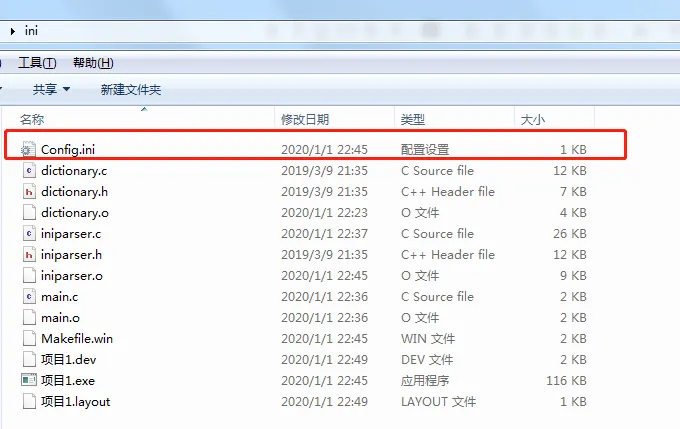
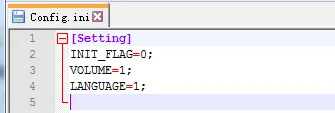
以文本格式打开可以看到如下:
INI解析库提供了我们用户最关心的两大方法,分别是设置方法和参数获取方法,在头文件iniparser.h中可以看到,这里请大家自己打开源码调用具体的方法去实验,说不定你有意外的收获噢。
iniparser.h
/*-------------------------------------------------------------------------*/
/**
   @file    iniparser.h
   @author  N. Devillard
   @brief   Parser for ini files.
*/
/*--------------------------------------------------------------------------*/
#ifndef INIPARSER_H
#define INIPARSER_H
/*---------------------------------------------------------------------------
                                Includes
 ---------------------------------------------------------------------------*/
#include <stdio.h>
#include <stdlib.h>
#include <string.h>
/*
 * The following #include is necessary on many Unixes but not Linux.
 * It is not needed for Windows platforms.
 * Uncomment it if needed.
 */
/* #include <unistd.h> */
#include "dictionary.h"
#ifdef __cplusplus
extern "C" {
#endif
/*-------------------------------------------------------------------------*/
/**
  @brief    Get number of sections in a dictionary
  @param    d   Dictionary to examine
  @return   int Number of sections found in dictionary
  This function returns the number of sections found in a dictionary.
  The test to recognize sections is done on the string stored in the
  dictionary: a section name is given as "section" whereas a key is
  stored as "section:key", thus the test looks for entries that do not
  contain a colon.
  This clearly fails in the case a section name contains a colon, but
  this should simply be avoided.
  This function returns -1 in case of error.
 */
/*--------------------------------------------------------------------------*/
int iniparser_getnsec(dictionary * d);
/*-------------------------------------------------------------------------*/
/**
  @brief    Get name for section n in a dictionary.
  @param    d   Dictionary to examine
  @param    n   Section number (from 0 to nsec-1).
  @return   Pointer to char string
  This function locates the n-th section in a dictionary and returns
  its name as a pointer to a string statically allocated inside the
  dictionary. Do not free or modify the returned string!
  This function returns NULL in case of error.
 */
/*--------------------------------------------------------------------------*/
char * iniparser_getsecname(dictionary * d, int n);
/*-------------------------------------------------------------------------*/
/**
  @brief    Save a dictionary to a loadable ini file
  @param    d   Dictionary to dump
  @param    f   Opened file pointer to dump to
  @return   void
  This function dumps a given dictionary into a loadable ini file.
  It is Ok to specify @c stderr or @c stdout as output files.
 */
/*--------------------------------------------------------------------------*/
void iniparser_dump_ini(dictionary * d, FILE * f);
/*-------------------------------------------------------------------------*/
/**
  @brief    Save a dictionary section to a loadable ini file
  @param    d   Dictionary to dump
  @param    s   Section name of dictionary to dump
  @param    f   Opened file pointer to dump to
  @return   void
  This function dumps a given section of a given dictionary into a loadable ini
  file.  It is Ok to specify @c stderr or @c stdout as output files.
 */
/*--------------------------------------------------------------------------*/
void iniparser_dumpsection_ini(dictionary * d, char * s, FILE * f);
/*-------------------------------------------------------------------------*/
/**
  @brief    Dump a dictionary to an opened file pointer.
  @param    d   Dictionary to dump.
  @param    f   Opened file pointer to dump to.
  @return   void
  This function prints out the contents of a dictionary, one element by
  line, onto the provided file pointer. It is OK to specify @c stderr
  or @c stdout as output files. This function is meant for debugging
  purposes mostly.
 */
/*--------------------------------------------------------------------------*/
void iniparser_dump(dictionary * d, FILE * f);
/*-------------------------------------------------------------------------*/
/**
  @brief    Get the number of keys in a section of a dictionary.
  @param    d   Dictionary to examine
  @param    s   Section name of dictionary to examine
  @return   Number of keys in section
 */
/*--------------------------------------------------------------------------*/
int iniparser_getsecnkeys(dictionary * d, char * s);
/*-------------------------------------------------------------------------*/
/**
  @brief    Get the number of keys in a section of a dictionary.
  @param    d   Dictionary to examine
  @param    s   Section name of dictionary to examine
  @return   pointer to statically allocated character strings
  This function queries a dictionary and finds all keys in a given section.
  Each pointer in the returned char pointer-to-pointer is pointing to
  a string allocated in the dictionary; do not free or modify them.
  This function returns NULL in case of error.
 */
/*--------------------------------------------------------------------------*/
char ** iniparser_getseckeys(dictionary * d, char * s);
/*-------------------------------------------------------------------------*/
/**
  @brief    Get the string associated to a key
  @param    d       Dictionary to search
  @param    key     Key string to look for
  @param    def     Default value to return if key not found.
  @return   pointer to statically allocated character string
  This function queries a dictionary for a key. A key as read from an
  ini file is given as "section:key". If the key cannot be found,
  the pointer passed as 'def' is returned.
  The returned char pointer is pointing to a string allocated in
  the dictionary, do not free or modify it.
 */
/*--------------------------------------------------------------------------*/
char * iniparser_getstring(dictionary * d, const char * key, char * def);
/*-------------------------------------------------------------------------*/
/**
  @brief    Get the string associated to a key, convert to an int
  @param    d Dictionary to search
  @param    key Key string to look for
  @param    notfound Value to return in case of error
  @return   integer
  This function queries a dictionary for a key. A key as read from an
  ini file is given as "section:key". If the key cannot be found,
  the notfound value is returned.
  Supported values for integers include the usual C notation
  so decimal, octal (starting with 0) and hexadecimal (starting with 0x)
  are supported. Examples:
  - "42"      ->  42
  - "042"     ->  34 (octal -> decimal)
  - "0x42"    ->  66 (hexa  -> decimal)
  Warning: the conversion may overflow in various ways. Conversion is
  totally outsourced to strtol(), see the associated man page for overflow
  handling.
  Credits: Thanks to A. Becker for suggesting strtol()
 */
/*--------------------------------------------------------------------------*/
int iniparser_getint(dictionary * d, const char * key, int notfound);
/*-------------------------------------------------------------------------*/
/**
  @brief    Get the string associated to a key, convert to a double
  @param    d Dictionary to search
  @param    key Key string to look for
  @param    notfound Value to return in case of error
  @return   double
  This function queries a dictionary for a key. A key as read from an
  ini file is given as "section:key". If the key cannot be found,
  the notfound value is returned.
 */
/*--------------------------------------------------------------------------*/
double iniparser_getdouble(dictionary * d, const char * key, double notfound);
/*-------------------------------------------------------------------------*/
/**
  @brief    Get the string associated to a key, convert to a boolean
  @param    d Dictionary to search
  @param    key Key string to look for
  @param    notfound Value to return in case of error
  @return   integer
  This function queries a dictionary for a key. A key as read from an
  ini file is given as "section:key". If the key cannot be found,
  the notfound value is returned.
  A true boolean is found if one of the following is matched:
  - A string starting with 'y'
  - A string starting with 'Y'
  - A string starting with 't'
  - A string starting with 'T'
  - A string starting with '1'
  A false boolean is found if one of the following is matched:
  - A string starting with 'n'
  - A string starting with 'N'
  - A string starting with 'f'
  - A string starting with 'F'
  - A string starting with '0'
  The notfound value returned if no boolean is identified, does not
  necessarily have to be 0 or 1.
 */
/*--------------------------------------------------------------------------*/
int iniparser_getboolean(dictionary * d, const char * key, int notfound);
/*-------------------------------------------------------------------------*/
/**
  @brief    Set an entry in a dictionary.
  @param    ini     Dictionary to modify.
  @param    entry   Entry to modify (entry name)
  @param    val     New value to associate to the entry.
  @return   int 0 if Ok, -1 otherwise.
  If the given entry can be found in the dictionary, it is modified to
  contain the provided value. If it cannot be found, -1 is returned.
  It is Ok to set val to NULL.
 */
/*--------------------------------------------------------------------------*/
int iniparser_set(dictionary * ini, const char * entry, const char * val);
/*-------------------------------------------------------------------------*/
/**
  @brief    Delete an entry in a dictionary
  @param    ini     Dictionary to modify
  @param    entry   Entry to delete (entry name)
  @return   void
  If the given entry can be found, it is deleted from the dictionary.
 */
/*--------------------------------------------------------------------------*/
void iniparser_unset(dictionary * ini, const char * entry);
/*-------------------------------------------------------------------------*/
/**
  @brief    Finds out if a given entry exists in a dictionary
  @param    ini     Dictionary to search
  @param    entry   Name of the entry to look for
  @return   integer 1 if entry exists, 0 otherwise
  Finds out if a given entry exists in the dictionary. Since sections
  are stored as keys with NULL associated values, this is the only way
  of querying for the presence of sections in a dictionary.
 */
/*--------------------------------------------------------------------------*/
int iniparser_find_entry(dictionary * ini, const char * entry) ;
/*-------------------------------------------------------------------------*/
/**
  @brief    Parse an ini file and return an allocated dictionary object
  @param    ininame Name of the ini file to read.
  @return   Pointer to newly allocated dictionary
  This is the parser for ini files. This function is called, providing
  the name of the file to be read. It returns a dictionary object that
  should not be accessed directly, but through accessor functions
  instead.
  The returned dictionary must be freed using iniparser_freedict().
 */
/*--------------------------------------------------------------------------*/
dictionary * iniparser_load(const char * ininame);
/*-------------------------------------------------------------------------*/
/**
  @brief    Free all memory associated to an ini dictionary
  @param    d Dictionary to free
  @return   void
  Free all memory associated to an ini dictionary.
  It is mandatory to call this function before the dictionary object
  gets out of the current context.
 */
/*--------------------------------------------------------------------------*/
void iniparser_freedict(dictionary * d);
#ifdef __cplusplus
}
#endif
#endif
废话不多说,拿来就想知道怎么用,那我们直接写一个操作例程就明白了,例程:
#include <stdio.h>
#include "iniparser.h"
#define CONFIG_NAME "Config.ini"
void Create_Default_InI_File(void)
{
    FILE *Default_ini = NULL ;
    Default_ini = fopen(CONFIG_NAME,"w");
    fprintf(Default_ini,
        "[Setting]\n"
        "INIT_FLAG=0;\n"
        "VOLUME=1;\n"
        "LANGUAGE=1;\n"
    );
    fclose(Default_ini);
}
int main(void)
{
  int Init_flag ;
  int Volume_flag ;
  int English_flag ;
  /*1、创建一个默认的Config.ini文件*/
    Create_Default_InI_File();
    /*2、解析Config.ini文件获得参数*/
    dictionary  *Config_ini = NULL;
    /*3、加载Config.ini文件*/
    Config_ini = iniparser_load(CONFIG_NAME);
    if(NULL == Config_ini)
    {
      printf("cannot parse %s file\n",CONFIG_NAME);
      return -1 ;
  }
  /*4、将字典转储到打开的文件指针。*/
  iniparser_dump(Config_ini,stderr);
  /*5、分别获取上述创建的InI文件里的几个项目的值*/
  Init_flag = iniparser_getint(Config_ini,"Setting:INIT_FLAG",-1);
  Volume_flag = iniparser_getint(Config_ini,"Setting:VOLUME",-1);
  English_flag = iniparser_getint(Config_ini,"Setting:LANGUAGE",-1);
  printf("Init_flag:%d\n",Init_flag);
  printf("Volume_flag:%d\n",Volume_flag);
  printf("English_flag:%d\n",English_flag);
  /*5、更改其中的INIT_FLAG项的值*/
  iniparser_set(Config_ini,"Setting:INIT_FLAG","1");
  Init_flag = iniparser_getint(Config_ini,"Setting:INIT_FLAG",-1);
  Volume_flag = iniparser_getint(Config_ini,"Setting:VOLUME",-1);
  English_flag = iniparser_getint(Config_ini,"Setting:LANGUAGE",-1);
  printf("Init_flag:%d\n",Init_flag);
  printf("Volume_flag:%d\n",Volume_flag);
  printf("English_flag:%d\n",English_flag);
  /*6、释放字典*/
  iniparser_freedict(Config_ini);
    return 0;
}
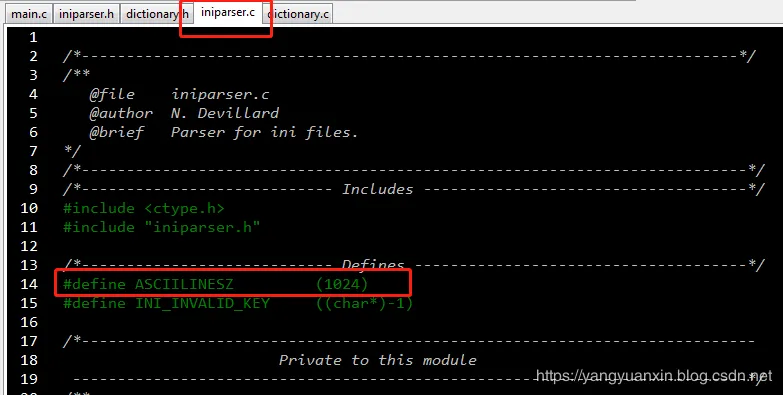
注意,如果要将iniparse库移植到单片机上时,要注意堆栈大小,因为在加载ini文件的时候,默认大小是1024个字节,如果单片机上的栈没有那么大的时候,我们要根据ini配置文件的大小去调节这个大小。
四、完整实验例程及库文件分享
链接:https://pan.baidu.com/s/1ny_-rKUqGi3O5f1x7ADBlg
提取码:w9bu
复制这段内容后打开百度网盘手机App,操作更方便哦