
在Java应用中,绝大多数情况下都是通过同步的方式来实现交互处理的。但是在处理与第三方系统交互的时候,容易造成响应迟缓的情况,之前大部分都是使用多线程来完成此类任务。其实在Spring 3.x之后,就已经内置了@Async来完美解决这个问题。
两个注解:@EnableAysnc、@Aysnc
【1】TaskExecutor
Spring异步线程池的接口类,其实质是java.util.concurrent.Executor。
Spring 已经实现的异常线程池:
① SimpleAsyncTaskExecutor:不是真的线程池,这个类不重用线程,每次调用都会创建一个新的线程。
② SyncTaskExecutor:这个类没有实现异步调用,只是一个同步操作,只适用于不需要多线程的地方。
③ ConcurrentTaskExecutor:Executor的适配类,不推荐使用。如果ThreadPoolTaskExecutor不满足要求时,才用考虑使用这个类 。
④ SimpleThreadPoolTaskExecutor:是Quartz的SimpleThreadPool的类。线程池同时被quartz和非quartz使用,才需要使用此类。
⑤ ThreadPoolTaskExecutor :最常使用,推荐。 其实质是对java.util.concurrent.ThreadPoolExecutor的包装。
【2】@Async注解
源码如下:
/**
 * Annotation that marks a method as a candidate for <i>asynchronous</i> execution.
 * // 将方法标记为异步执行
 * Can also be used at the type level, in which case all of the type's methods are
 * considered as asynchronous.
 *// 也可以在类型级别使用,在这种情况下,所有类型的方法都被认为是异步的。
 * <p>In terms of target method signatures, any parameter types are supported.
 * // 目标方法中,可以支持任何类型的参数
 * However, the return type is constrained to either {@code void} or
 * {@link java.util.concurrent.Future}.
 * // 然而,返回类型要么是void,要么是Future
 * In the latter case, you may declare the
 * more specific {@link org.springframework.util.concurrent.ListenableFuture} or
 * {@link java.util.concurrent.CompletableFuture} types which allow for richer
 * interaction with the asynchronous task and for immediate composition with
 * further processing steps.
 *
 * <p>A {@code Future} handle returned from the proxy will be an actual asynchronous
 * {@code Future} that can be used to track the result of the asynchronous method execution.
 * // 代理返回的Future可以用来跟踪异步方法处理的结果
 * However, since the target method needs to implement the same signature,
 * it will have to return a temporary {@code Future} handle that just passes a value
 * through: e.g. Spring's {@link AsyncResult}, EJB 3.1's {@link javax.ejb.AsyncResult},
 * or {@link java.util.concurrent.CompletableFuture#completedFuture(Object)}.
 *
 * @author Juergen Hoeller
 * @author Chris Beams
 * @since 3.0
 * @see AnnotationAsyncExecutionInterceptor
 * @see AsyncAnnotationAdvisor
 */
@Target({ElementType.METHOD, ElementType.TYPE})
@Retention(RetentionPolicy.RUNTIME)
@Documented
public @interface Async {
    /**
     * A qualifier value for the specified asynchronous operation(s).
     * <p>May be used to determine the target executor to be used when executing this
     * method, matching the qualifier value (or the bean name) of a specific
     * {@link java.util.concurrent.Executor Executor} or
     * {@link org.springframework.core.task.TaskExecutor TaskExecutor}
     * bean definition.
     * <p>When specified on a class level {@code @Async} annotation, indicates that the
     * given executor should be used for all methods within the class. Method level use
     * of {@code Async#value} always overrides any value set at the class level.
     * @since 3.1.2
     */
    String value() default "";
}
【3】无返回值代码示例
Service如下:
@Service
public class AsyncService {
    @Async
    public void hello(){
        System.out.println("进入service。。。");
        try {
            Thread.sleep(3000);
            System.out.println("3S后数据开始处理中。。");
        } catch (InterruptedException e) {
            e.printStackTrace();
        }
    }
}
Controller如下:
@RestController
public class AsyncController {
    @Autowired
    AsyncService asyncService;
    @GetMapping("/hello")
    public String hello(){
        System.out.println("进入Controller。。。");
        asyncService.hello();
        return "success";
    }
}
Service的方法上使用了@Async注解,如果使该注解起作用,则需要在主程序上添加@EnableAsync注解。
@SpringBootApplication
@EnableAsync
public class SpringBoot01CacheApplication {
    public static void main(String[] args) {
        SpringApplication.run(SpringBoot01CacheApplication.class, args);
    }
}
浏览器发起请求,控制台打印如下:
进入Controller。。。
2018-07-08 11:10:30.305  INFO 3996 --- [io-8080-exec-10] .s.a.AnnotationAsyncExecutionInterceptor : No task executor bean found for async processing: no bean of type TaskExecutor and no bean named 'taskExecutor' either
进入service。。。
3S后数据开始处理中。。
【4】使用Future获取异步方法返回值
Service如下:
 /**
     * 异步调用返回Future
     *
     * @param i
     * @return
     */
    @Async
    public Future<String> asyncInvokeReturnFuture(int i) {
        System.out.println("进入asyncInvokeReturnFuture...");
        Future<String> future;
        try {
            Thread.sleep(3000);
            System.out.println("3S后asyncInvokeReturnFuture数据开始处理中。。");
            future = new AsyncResult<String>("success:" + i);
        } catch (InterruptedException e) {
            future = new AsyncResult<String>("error");
        }
        return future;
    }
Controller修改如下:
    @GetMapping("/hello")
    public String hello(){
        System.out.println("进入Controller。。。");
        asyncService.hello();
        Future<String> future=asyncService.asyncInvokeReturnFuture(300);
        String s = null;
        try {
            s = future.get();
        } catch (Exception e){
            e.printStackTrace();
        }
        System.out.println("异步方法返回值 : "+s);
        return s;
    }
}
控制台打印如下:
进入Controller。。。
2018-07-08 11:42:55.660  INFO 8152 --- [nio-8080-exec-2] .s.a.AnnotationAsyncExecutionInterceptor : No task executor bean found for async processing: no bean of type TaskExecutor and no bean named 'taskExecutor' either
进入service.hello()。。。
3S后hello数据开始处理中。。
进入asyncInvokeReturnFuture...
3S后asyncInvokeReturnFuture数据开始处理中。。
异步方法返回值 : success:300
【5】配置自定义线程池
源码示例如下:
@Configuration
public class MyExecutorConfig {
    /**
     * 自定义异步线程池
     * @return
     */
    @Bean
    public AsyncTaskExecutor taskExecutor() {
        ThreadPoolTaskExecutor executor = new ThreadPoolTaskExecutor();
        executor.setThreadNamePrefix("Anno-Executor");
        executor.setMaxPoolSize(100);
        // 设置拒绝策略
        executor.setRejectedExecutionHandler(new RejectedExecutionHandler() {
            @Override
            public void rejectedExecution(Runnable r, ThreadPoolExecutor executor) {
                // .....
            }
        });
        // 使用预定义的异常处理类
        // executor.setRejectedExecutionHandler(new ThreadPoolExecutor.CallerRunsPolicy());
        return executor;
    }
}
修改service再次测试如下:
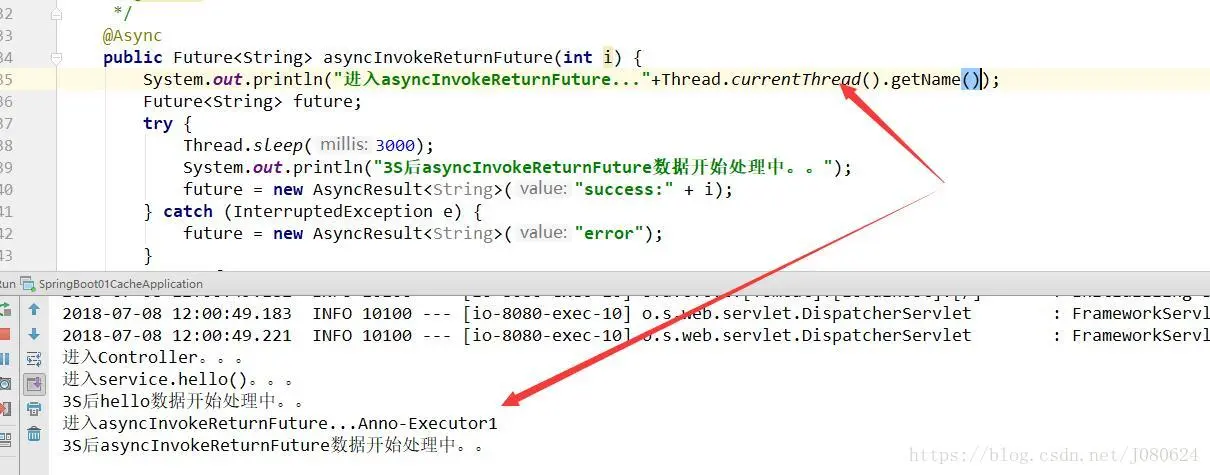
说明使用了自定义异步线程池!
